
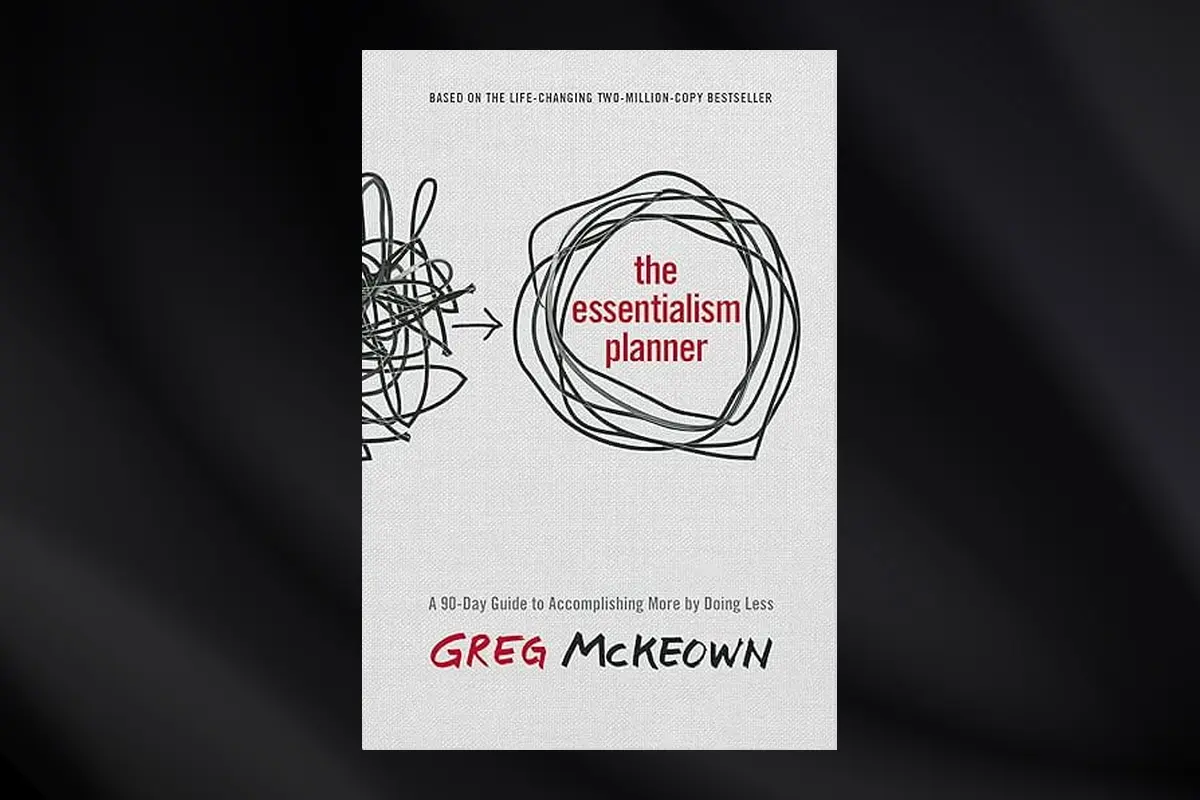
More stuff, more hours, more stress, more money—if you are overwhelmed, stressed out, questioning if your life makes sense, Essentialism is for you. The subtitle strikes a chord with me: “The disciplined pursuit of less.”
Disciplined—It takes effort to choose your priorities and make decisions that go against the flow of the “more, more, more” culture around you.
Pursuit of Less—This phrase is the opposite of what we expect. We usually link pursuing with “more”, but in today’s world, most of us need less.
Author Greg McKeown, a leadership consultant, writes, “In my work I have seen people all over the world who are consumed and overwhelmed by the pressures all around them. I have coached ‘successful’ people on the quiet pain of trying desperately to do everything, perfectly, now.”
McKeown tells how he felt pressured to attend a client meeting the day his daughter was born. He went to the meeting but later regretted his misplaced priority.
Essentialism vs. Nonessentialism
To better understand Essentialism, we can look at its opposite, Nonessentialism. A Nonessentialist . . .
- Asks, “How can I fit it all in?”
- Reacts to what is most pressing.
- Says yes to people without really thinking.
- Tries to force execution at the last moment.
- Takes on too much, and work suffers.
- Feels out of control.
- Is unsure of whether the right things get done.
- Feels overwhelmed and exhausted.
By contrast, McKeown promotes becoming an Essentialist, someone who . . .
- Realizes only a few things really matter.
- Thinks about the trade-offs.
- Pauses to discern what really matters.
- Says no to everything except the essential.
- Removes obstacles to make execution easy.
- Chooses carefully in order to do great work.
- Feels in control.
- Gets the right things done.
- Experiences joy in the journey.
The Paradox of Success
McKeown points out the “paradox of success” as one culprit behind Nonessentialism. I’ll paraphrase and summarize the steps of the paradox here.
- We start becoming successful/effective in our work.
- As a result, we gain additional responsibilities and opportunities.
- These additional demands on our time and energy spread us too thin.
- Therefore, we no longer contribute at our highest level.
- In the paradox of success, success can lead to eventual failure.
We can neither have it all, nor do it all. We need to learn to say no, which means making hard choices. If we don’t understand the necessity of trade-offs, we find ourselves bogged down and overcommitted.
Essentialism is not about getting more done but about doing fewerthings better. In broad strokes, here are McKeown’s three steps to help us do that.
1. Explore and Evaluate. This step helps us sort out our priorities. In some areas, we benefit from stark clarity: “If it isn’t a clear yes, then it’s a clear no.”
McKeown urges us to set aside time where we can think—where we can design, concentrate, and read. He suggests that we need to take time to play and sleep. “Sleep is what allows us to operate at our highest level of contribution so that we can achieve more, in less time.”
2. Eliminate. Once we understand our priorities, something has to go. McKeown discusses how hard it is to say no to others. It can be socially awkward, and we worry about missing out on something or losing respect. Here are a few of his suggestions for saying no:
- “No, but…” For example, “No, I can’t meet with you this week, but we can arrange for next week.”
- “Let me check my calendar and get back with you.” This gives you time to reflect.
- “Yes. What should I deprioritize?” You can’t tell your boss no, but you can ask for guidance on setting your top priority.
3. Execute. When planning our days, many of us cram as much as possible into a day, assuming a best-case scenario. An Essentialist, on the other hand, expects complications and builds in buffers, which decreases stress.
Which do you think is more effective: hoping for a big win or consistently creating small wins? McKeown promotes the latter, moving ahead one small step at a time. He suggests taking advantage of the power of a simple routine.
Takeaway
In the last chapter, McKeown recaps: “The life of an Essentialist is a life of meaning. It is a life that really matters.” For me, the greatest value of this book was catching McKeown’s vision of cutting back, no longer trying to do everything, and focusing on what we can do best and enjoy the most.
McKeown is a Mormon. Examining his approach from a Biblical perspective, I can see where some people would apply his teaching selfishly. For example, being an Essentialist might lead me to refuse to take time for someone if it does not help me achieve my goals. This selfish mindset contradicts Jesus’ teaching.
In spite of this caveat, Essentialism is a needed concept. We should reject the American dream of more, simplify our lives, and focus on fewer things to increase our effectiveness and our peace of mind.
Disclaimer: Many of the books being reviewed in this section are written by authors who may not share our Anabaptist values. While the books contain beneficial and constructive principles for business management, you may occasionally encounter terminology that is not endorsed by the Anabaptist reader. Please read with discretion.