
Today I told Claude (a popular AI-based program) to do the following:
Create me a budget for a $2,000,000 construction company. The budget should have 3 sections: Revenue, Cost of Construction and Fixed Expenses. Include a gross profit line after Cost of Construction and include a Net Income line at the very bottom. I want the budget to have a column for each month of 2026 plus a Total column. Create the budget with fully functioning Excel formulas, so I can change assumptions and automatically update the entire budget. Assume a 30 percent gross profit margin, but build the budget so there’s a field where I can change the 30% and it will change the whole budget. In the Fixed Expenses section, list the expense categories that would normally be fixed expenses for a construction company of this size. Input monthly budget numbers that you feel would be reasonable for a company of my size.
Claude worked five minutes and produced this fully functional 2026 budget for a $2M construction company. The image below is the first-draft, completely unedited except for column width.
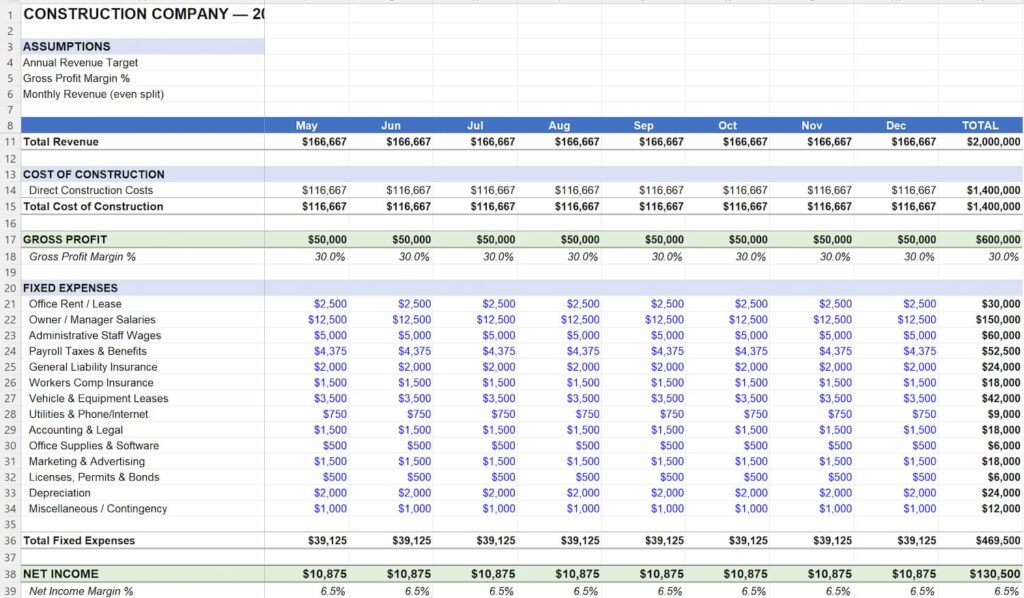
Note: Months April to September are hidden to make the spreadsheet more readable.
Everything you see was completely created by AI: the spreadsheet itself, the numbers in the spreadsheet (which at first glance appear very reasonable), and the formulas.
I can easily change the assumptions at the top, which instantly updates the whole projection. I can manually change any of the blue fixed expense numbers, or add expense categories.
This is truly game-changing! What would have taken many minutes, if not hours, for a skilled accountant to do before, can now be done instantly and automatically using AI.
This is not science fiction. If you have Microsoft Excel, you can purchase the Claude add-on, copy my prompt, and immediately do the same thing for your company.
Should you?
The major US tech companies hope you do!
For 2026 alone, Microsoft, Amazon, Meta, and Google are projected to spend over $600 billion building AI data centers and programs. For perspective, $600B is equal to the entire federal spending budgets of large countries such as Germany or Brazil.
How are conservative Christian business owners supposed to think about all this? Where is this headed?
As an Anabaptist business owner and accountant, I’ll give you my perspective.
Please note: My perspective is just that, and is based on incomplete information subject to change. Plus, this is a short article on a LARGE topic. We are only covering the proverbial tip of the iceberg.
Read on at your own risk!
General Thoughts About AI
1. AI is not truly “artificial intelligence.” I’m not sure where the term came from, but AI programs (like Claude) are programmed software tools, not agents that possess biological human reasoning. The new tools are indeed far more powerful than past technologies, and are programmed to process information in a manner similar to humans, but that does not mean they possess true intelligence.
2. The fear that AI will destroy humanity is equally ungrounded. We serve a Creator who will not allow man (or AI!) to destroy the whole earth. God has a plan, and it doesn’t involve AI eliminating his entire beloved creation. There will be humans living on the earth when Christ returns. If not, our faith is vain.
3. People are likely overestimating the short-term impact of AI, and underestimating the long-term impact. Elon Musk has been promising self-driving cars for a decade, and they still aren’t widely available. AI will take time to implement as well. In the long-term though, once the flywheel gains momentum, the effect will likely be huge. I don’t believe AI is a small issue.
4. AI will likely eliminate some industries and reshape others. Just like the loom eliminated the jobs of weavers who made fabric by hand, AI will eliminate whole industries that are based on repetitive tasks or staring at a screen or windshield. Many industries (like accounting) will almost certainly see elements of their daily work eventually disappear.
In some ways it was never natural for humans to stare at a windshield or computer screen all day anyway. Trucks and computers replaced a lot of human work when they first came out. Now AI is advancing them to where they don’t need humans at all! You could argue it is simply the inevitable progression of technology.
5. I don’t believe AI will create mass unemployment. There is reasonable fear that as AI takes away work from humans, the humans will become jobless and discouraged. I think this is overblown. Sure, some people will likely need to find other types of work. But people are adept at doing just that! Like the moldboard plow, the tractor, the computer, and countless tools before, I predict AI will help humans, not put them out of work.
Special Considerations for Anabaptists
1. If you haven’t used computer technology or the internet to date, AI may not affect you as much (at least right away). AI is automating use of technology already in place. For example, a human used to manually create a budget using Microsoft Excel on a computer. Now AI will do it automatically. If you’ve been budgeting on paper for the last 40 years, nothing will change!
2. If you outsource use of technology to others, consider finding people who are skilled in using AI. No need to pay someone to manually create a budget in Excel when you can find a skilled AI-supported accountant to do it much faster. The same goes for marketing research, coding, drawing, etc.
3. On the flip side, beware of AI “slop.” Lazy operators (e.g. lazy accountants) will increasingly create proposals, research, budgets, accounting reports, etc. using AI without taking the time to verify accuracy or add a human touch. I estimate greater than 50% of AI-produced material is pretty much worthless because it’s been produced by lazy or uninformed people who don’t have the expertise or desire to make sure it makes sense. This is a huge problem, that will likely get worse.
4. Beware of AI “companionship.” This may sound like a completely stupid point, but it isn’t. Because AI chatbots (e.g. Claude, Grok, Gemini, and ChatGPT) are designed to sound like humans, they are believable and relatable, despite being mindless and unhuman. This creates an alternate universe where people develop relationships with AI, like they would another person. This presents massive danger, particularly for young, vulnerable, or relational people.
5. If you use AI in your company, implement clear boundaries. At Hoover Financial, we are contemplating a framework to guide how we use AI. For example, we are moving full-speed ahead using AI as an ordinary tool for our work (e.g. making spreadsheets faster). But for client-facing actions (e.g. writing an email or delivering recommendations) we will require a strong human component. This article was fully written by a human (me)!
6. Be very slow to allow apprentices and young people to use AI. I don’t make this point due to moral danger (although that is a danger too, like anything on the internet). I make this point because I believe AI will stifle human creativity, hinder learning, and reduce the ability to memorize and store knowledge. In fact, I wonder how the next generation is going to develop critical thinking skills when AI will gladly do most of the thinking for them. As with past technology, apprentices need to develop their skills manually before moving to automation. I know, I know, when the calculator came out, people said we’d all be dumb at math. AI seems a bit more impactful than the calculator, but I certainly could be wrong.
7. In seeking a vocation, lean toward “anti-AI.” I predict a weird world will soon emerge where people value non-AI productions. For example, hand-crafted cards or art, hand-sewn clothes, custom furniture, personal consulting, etc. might all rise to new levels of demand as people get sick of AI automation and perfection. Of course, the trades, construction, manufacturing, etc. appear to be AI-proof for the foreseeable future as well. It might be prudent to head in those directions, rather than say long-distance truck driving or bookkeeping, which may ultimately be replaced by AI tools.
8. Make sure everything is “honest in the sight of all men.” AI will provide incredible opportunities for dishonesty. From fake photographs, to fake videos, to having ChatGPT create a complete sermon you haven’t studied at all, AI will be a great enabler of all things fake and imitation. This may be the greatest threat AI brings to Christians. Now is the time to set clear personal and business boundaries.
Conclusion
Being a Christian (and a business owner!) is an active thing. Our Creator doesn’t want us to sit back and coast obliviously through life. Jesus told us to “Watch” and “Pray” and “Study” and “Trust.”
Applying that to AI, we need to be aware, but not afraid. As with any other issue, we need to make wise decisions. I think AI will just be another tool (albeit a major one) that must be considered and respected, but not feared.
And I urge you not to stick your head in the sand. This issue is moving in fast and even if you abstain from use of technology, it will begin to affect your daily life soon. Now is the time to think and prepare.
If you feel overwhelmed managing the finances of your growing company, contact Hoover Financial to discuss options for fractional CFO oversight. This option works well for growth companies with $5M+ revenue. Call 715.615.1344 or email scott@hoover.financial.
Scott lives in Wisconsin with his wife Priscilla and their nine children. In addition to his CPA work, he and his family have a small farm where they raise produce and a few animals. In his spare time, he enjoys writing articles on finance and faith.