
Each year in late summer, TJ and Marcia Bear consider the merits of the U-Pick (Pick-Your-Own) blueberry business. “We get to the 20th of August,” TJ says, “and we look at each other with our tongue hanging out, and we’re like, ‘Can we do this another year?’”
Even Marcia, who loves gardening, is thinking, This is stupid, by the end of the season.
TJ, an accountant and former aircraft mechanic, could never be accused of loving to garden. But after a few months of rest, things look different. “Well, time to go prune,” one of them will say in December. They discuss the fact that they had decided to quit after last year, but then they always conclude, “No, we’re not quitting. Let’s go prune.”
Becoming a Blueberry Farm Family
TJ Bear grew up in Ohio. He moved to Oregon after getting to know Marcia. They were dating, but Marcia didn’t enjoy writing—not even letters. TJ, who does enjoy writing, finally just moved to Oregon rather than wait by the mailbox. A year later, the two married on September 14, 2001, three days after the terrorist attacks on the east coast.
TJ had found a job as a mechanic at a small airport in Salem, working general aviation on privately owned planes. The terrorist attacks disrupted the aviation industry, and Marcia’s dad needed help on the farm, so TJ became a farmer, first helping his father-in-law and then farming some of his own land. In 2009, TJ and Marcia and their growing family moved onto an existing blueberry farm. They raised both blueberries and strawberries, mostly for selling to other locations rather than U-Pick.
“My goal in the whole farming enterprise all along was, I guess, wanting to be family-oriented,” TJ says. “The fruit thing was really neat in the sense that we could work at it as a family.”
What was not really neat was the frenetic pace. For their children, summer vacation was almost entirely consumed first by strawberries and then blueberries. As a matter of survival, the Bears finally quit raising strawberries. Eventually, TJ chose to get out of farming as his main career.
“It was counterintuitive to me,” TJ said, “I had construction and mechanical background, but no farming background at all. So green living things was not my—I’m not instinctive with it… I finally concluded I was not a born farmer. I’m not good at it. She’s good at it,” he says of Marcia. “She’s amazing.”
TJ began working in other industries, eventually beginning his own accounting business. But they kept the blueberry farm as a way to still meet the goal of having family work to do together.
From Wholesale to U-pick
When TJ and Marcia first started running Bear Fruit, TJ took blueberries to market. His Chevy Aveo, a small car by any standards, turned out to be a perfect market vehicle. “You wouldn’t believe,” TJ says. “You can put a whole day’s market in that thing.”
He would open the hatch, flip the back seats forward, and stack 40 flats of blueberries into the back, along with his tent and table. In addition, the small vehicle came out ahead at the markets where parking was forbidden unless you could fit your vehicle in the stall along with your market tent. TJ would back the small car in, open the hatch, and raise his tent right over the back of the car.
In those days, in the 2010 era, TJ could sell 40 ten-pound boxes of blueberries for $40 a box and be sold out by noon.
Then, several things happened. There had always been large blueberry farms in the Willamette Valley, and already there were farms using mechanical pickers. However, there was a shift in the commodities market, and the large farms that could no longer make as much money by sending their berries across the country began to flood the local market. Soon, as TJ was selling his 10-pound boxes of blueberries at market for $40, he found people beside him selling the same box for $15.
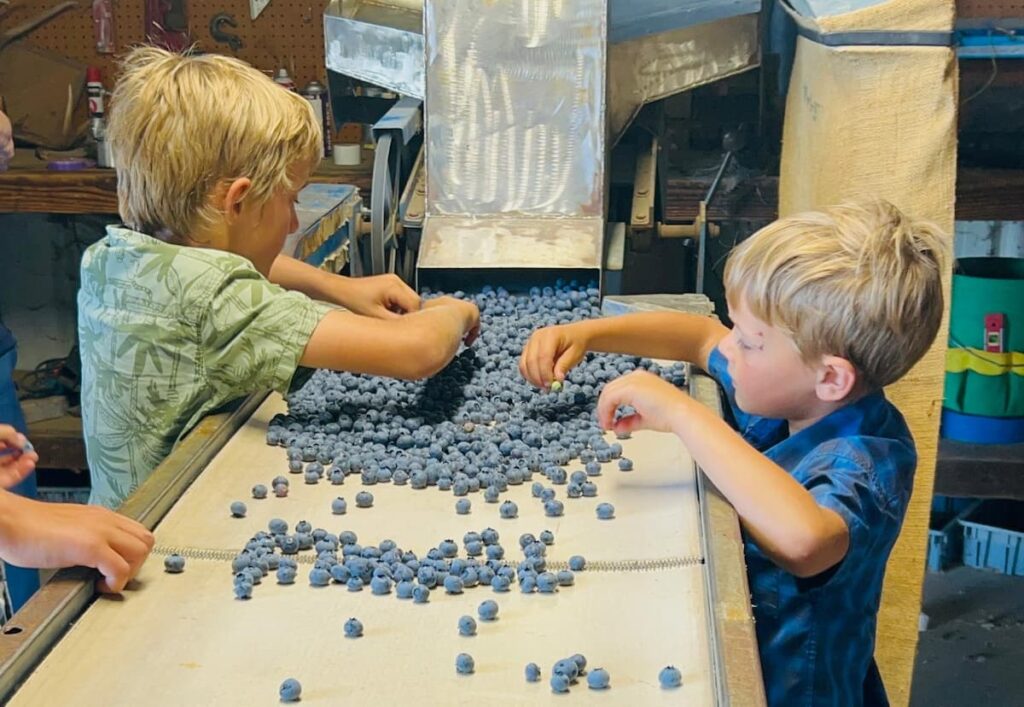
TJ and Marcia realized that the future of their small patch was probably U-pick. The blueberry farm had started off by hiring 15 to 20 pickers a day to pick 1,000 to 2,000 pounds of blueberries for wholesale markets, grocery stores, and farmers markets. Berries were poured into a hopper that advanced the fruit along a belt where it could be sorted by hand. At that time, they turned U-pick customers loose on the rows following the hired pickers, making the U-pick experience almost like gleaning.
Once they saw that growing the U-pick market was essential, they let U-pick customers pick first, roping off a section for their own pickers. The cordoned patch for hired pickers continued to shrink as the U-pick customers increased, until finally they quit cordoning. Now, the system is switched—the Bear family “gleans” after the U-pickers.
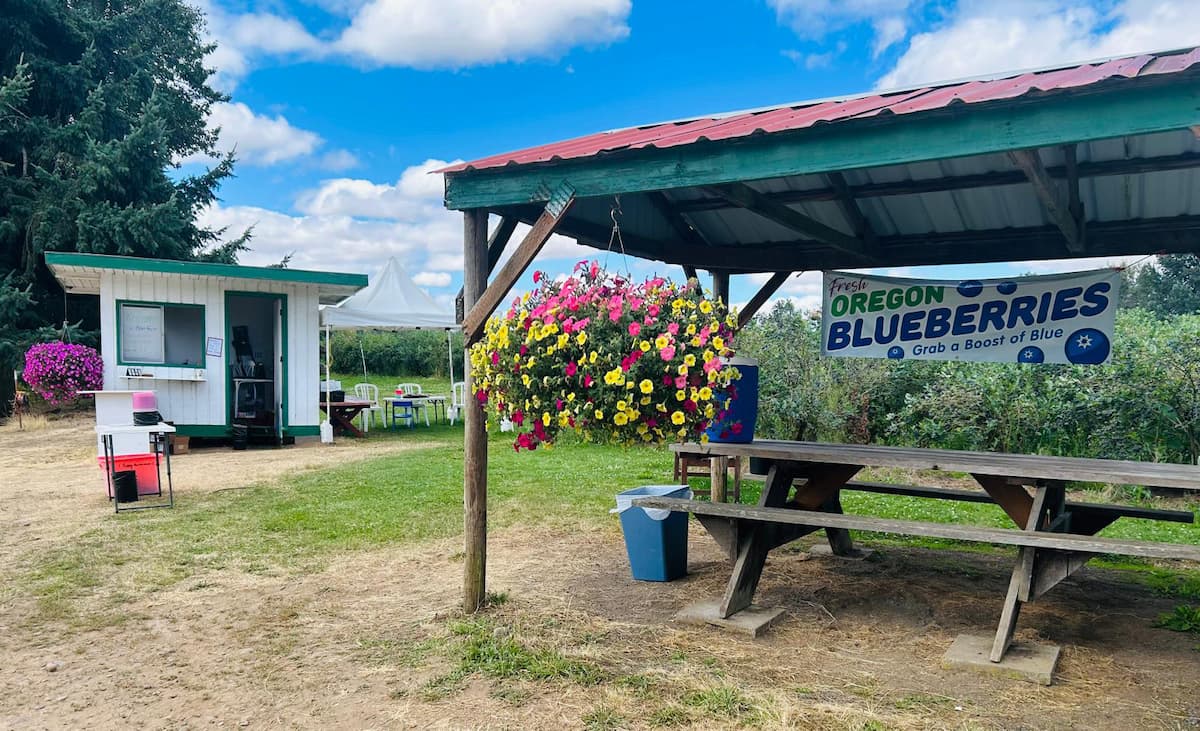
TJ did continue at the markets for a time, even though margins had reduced to almost nothing, because it was a good way to market the rural U-pick farm. Marcia made the patch U-pick friendly by adding flowers and a picnic table. They expanded their retail products to include local honey (from bees that pollinate their patch), soap made with dried blueberries, candles and fresh baked blueberry muffins. They also sell frozen berries year-round.
Unlike some local U-pick patches, they maintain a grass strip between the blueberry rows. While it needs to be maintained and mowed, it offers a superior customer experience. Marcia has heard comments about the park-like appeal of the patch as she picks across the bush from customers.
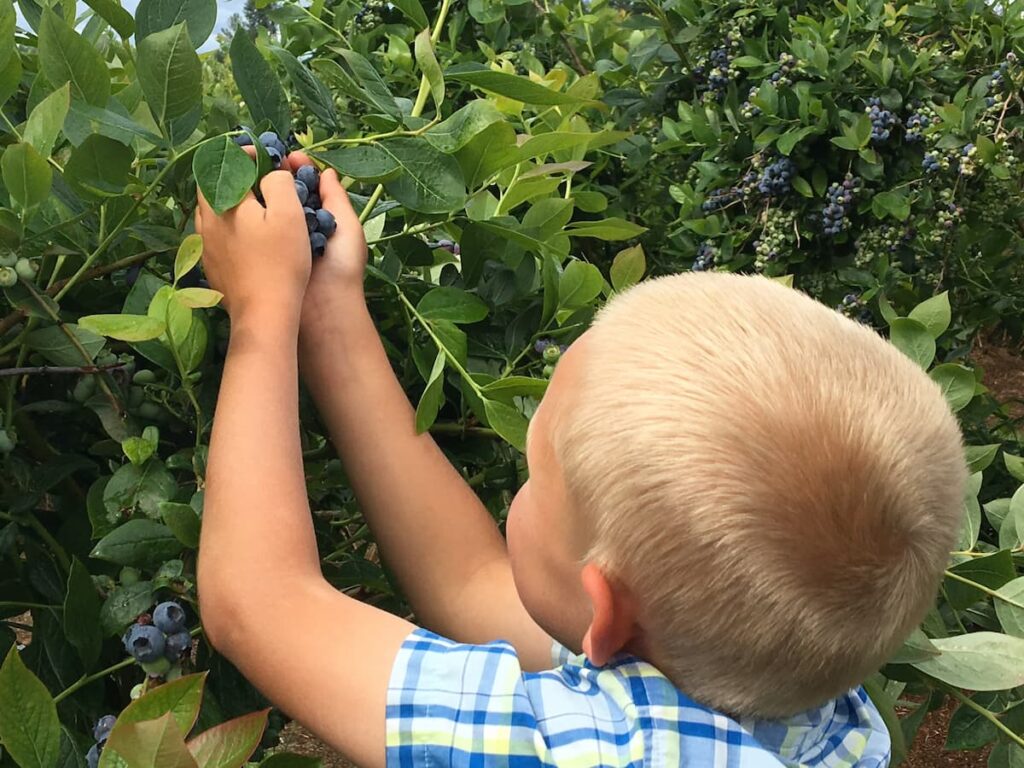
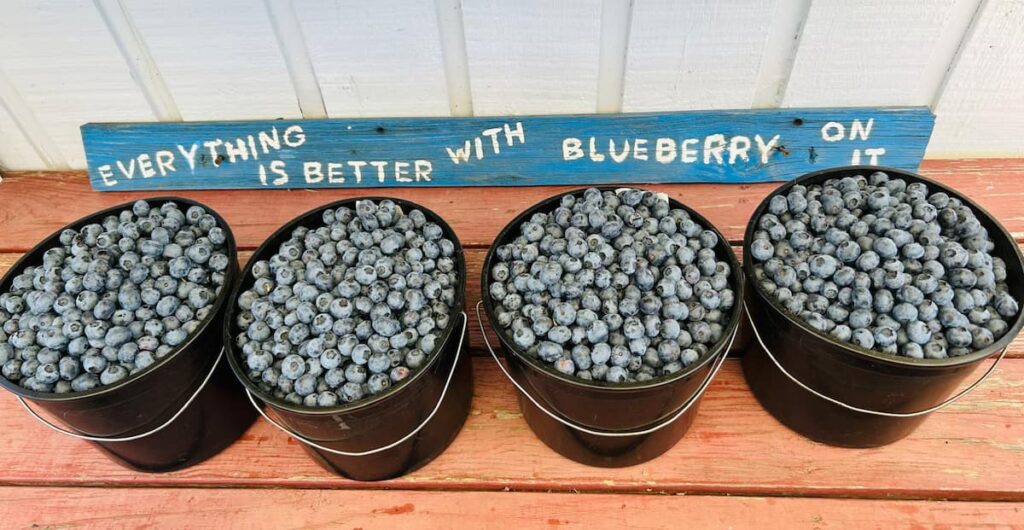
By now, in 2026, almost 90% of sales are to U-pick customers. Bear Fruit does still pick some berries, but instead of 1,500 pounds a day, it might be 100 pounds, picked by Marcia and the children.
Dealing with Pests
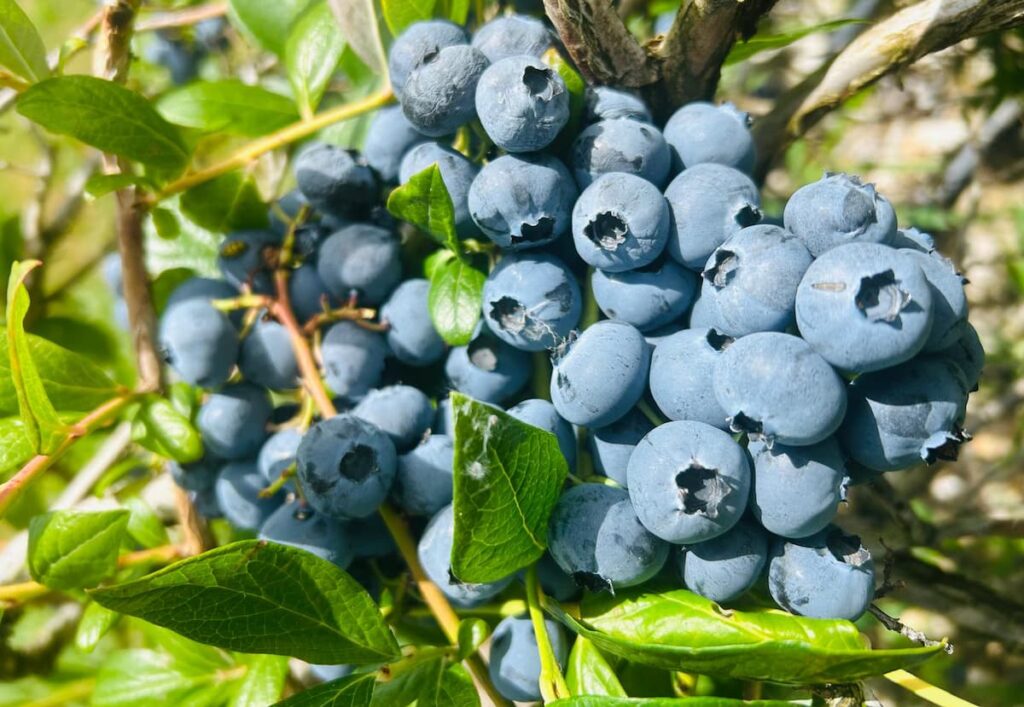
Pests are always an issue for a blueberry patch. Bear Blueberry Farm deals with deer, mice, moles, and birds. TJ traps moles frequently and uses poison on the mice. They tried netting to stave off the birds but found that it was both expensive and difficult. Shooting at the birds didn’t seem to make an appreciable difference.
“The most effective thing I ever did,” TJ says, “it was wonderful because it was fun, and it was effective. I got a radio-controlled airplane. I went out there and started flying over the patch. I was just curious… Wonder if I can scare the cedar waxwings out of the blueberries with this thing?”
He tried it a few times, navigating the airplane over the patch, but it didn’t seem to have much effect. The birds might move to another bush, but they didn’t seem to be leaving.
“One day, I thought, well, maybe I should swoop at them like a hawk does. And I mean, that was magic… And you do that a couple days in a row, and they leave and don’t come back. They will mark an area where they’ve been harassed, if it actually scares them good.”
Now, a 50-acre commercial blueberry field has moved in just down the road, and they no longer have bird problems of any kind. The birds have an even better place to live, since that patch doesn’t have U-pick people present.
Bear Fruit has leaned heavily organic for a number of years, but TJ does make an exception if necessary. A few years ago, an Asian fruit fly arrived with imported fruit and began to wreak havoc on blueberries.
“Your native fruit flies are only attracted to overripe fruits,” TJ explains. “That’s why you always see them hanging around on the mushy stuff on the counter. These Asian fruit flies are called Spotted Wing flies. They came in, and they were capable of puncturing firm fruit, and so they would come in as the blueberries are ripening, punch the fruit, lay their eggs, and about the time you go to pick them, it looks like a big, beautiful, perfect blueberry, and you pick it, and it just collapses, and it’s full of maggots.”
TJ sprays for these pests, but he has learned to manage them mostly with organic sprays. People assume that being organic means a person doesn’t spray. The reality is that there are a lot of organic sprays available on the market.
Irrigation and Pruning
When TJ and Marcia bought the blueberry farm, it was already set up with an irrigation system above the plants instead of a drip line at the base of the plants. A university researcher had suggested that the drip line below would be beneficial to reduce disease. But TJ and Marcia have found the “raining effect” of the higher irrigation has advantages. On the very hottest days, turning on the irrigation cools the berries down and keeps them from cooking in the sun.
A few years ago, the valley experienced an abnormally hot stretch. “We had a stretch of weather where it was 110 degrees for two weeks,” TJ remembers.
Many other blueberry farms ended their season, since the berries were basically broiling in the sun. But Bear Fruit turned the irrigation on as soon as the customers were gone each night, and the plants cooled down.
In addition, Oregon is very dry during the summer, with humidity 20% or less and generally no rain. Dust rolls through the air and many berry farms have dirty plants to the point that you might not want to eat berries while picking but rather wait to take them home and wash them. But at Bear Fruit, the berries stay clean and fresh.
The overhead irrigation is also helpful to people concerned with sprays. Because of the overhead irrigation, the berries get washed frequently.
TJ began with a pruning strategy known as a top prune, where the bush is shortened by cutting and thinning branches on the top. However, TJ found that the bush wanted to grow faster wherever he cut, meaning there were even more shoots in that area the next year.
Finally, the Bears heard of a pruning expert from Vancouver Island and took a family trip north to visit him. “He taught me some principles that totally changed my pruning techniques,” TJ says. “One principle being that when you cut, you always go back to a junction of equal size.”
TJ explains that the bigger the branch, the more juice flows through it. So if you select a branch you want to cut, you should follow it back until you get to a branch of equal size. If you cut there, the cut part won’t be so flooded with energy from the plant.
“But what we learned works even better than that,” TJ adds, “We go all the way to the base, and we just cut at the base. We literally go out there with a Sawzall and cut 25 to 30 to 40% of the carcass out at the base… We virtually don’t touch the top anymore.”
Community Connection
In most of TJ’s previous career experience, he wasn’t directly customer-facing. With a U-pick patch though, he says, “You’re kind of presenting yourself to people day in and day out.”
The blueberry patch is right beside the Bear family home. “So when I’m bawling out one of my boys up there on the porch,” he says, “the leftover U-picker that you forgot is still out there, gets to hear you exactly how you are. For that period of time, every year, we just get this reminder that how you actually are, actually matters.”
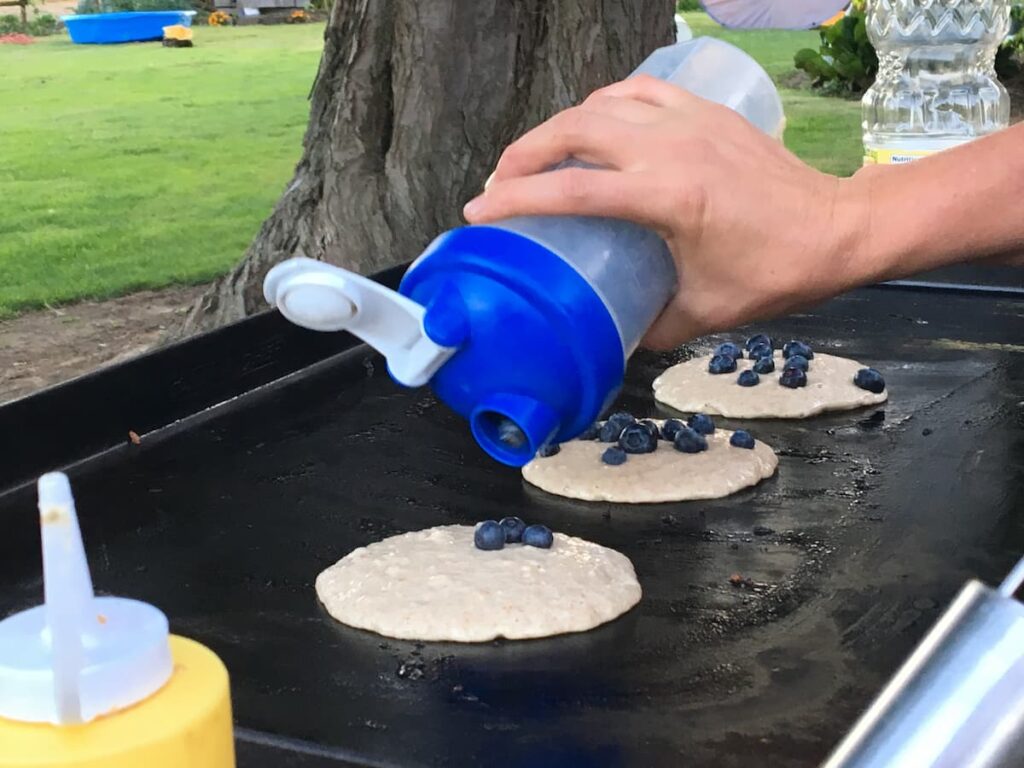
For the last few years, Bear Fruit Farm has hosted a Blueberry Pancake Feed on a Saturday during the season. On Blackstone griddles, they fry pancakes with fresh blueberries dropped in them. Marcia makes a large pot of stewed blueberries as a topping, and real maple syrup is offered.
“People absolutely love it,” TJ says. “So all the neighbors come and they just sit around and visit. It’s like the neighbor reunion.”
Even for non-neighbors the blueberry farm is a good way to get out into the country. The fact that Bear Fruit is on a dead-end road appeals to some people.
“We often say we sell fresh air as much as blueberries,” Marcia says.
TJ believes that a lot of people come for an “outdoor experience that’s genuine.”
They don’t have a petting zoo like some experience-driven farms, “But there’s horses in the pasture because we have horses. There’s cattle over there because the neighbors have cattle.”
Customers are often intrigued by the Bear children. “Your children actually can carry a conversation,” they might say, or, “My grandchildren, all they’ll do is look at a phone.”
For TJ and Marcia, the best thing about a blueberry farm is the community connection. “That’s what keeps us from quitting,” Marcia says.
TJ agrees that the community is a huge part of what gets them out to prune each year. “I guess 50% of it is work for the children, and the other 50% is the community connection.”
This doesn’t mean they aren’t exhausted at the end of the season. But come December, they’ll be ready to go again.

TJ and Marcia Bear are raising their family in a Mennonite community in Oregon, where hard work and simple living still mean something. You can find Bear Fruit at 30595 Wyatt Drive in Harrisburg, OR, 97446. If you need to call, you can reach TJ at 541.521.7721.
Katrina is the author of eighteen books, most recently the Brady Street Boys adventure series. She lives with her husband Marnell and their daughter in Elkhart, Indiana.