
Vernon Yoder was about nine years old when his father began tripping over nonexistent objects. He would look to see what had caused him to fall, but there was nothing there. After repeated trips to the doctor, Howard Yoder finally received a diagnosis: he had a chronic muscle-weakening disease, polymyositis.
A farmer, Howard Yoder saw that he needed a different vocation. His wife, Ida, was known in the community for her cinnamon rolls and other baked goods, so starting a bakery seemed like a good idea.
“Out here in the country, this bakery, it will never go,” a relative said. But Howard and Ida persisted. They sold the farm, retaining a portion of the land on which to build a bakery and house, and went into business. It was the beginning of Country Lane Bakery.
The Boy Who Wanted Real Food
The youngest of six siblings, Vernon helped occasionally in the bakery throughout his school years. However, his real love of food preparation hit him when his next oldest sister graduated from school and quit making breakfast for herself and Vernon. She joined the rest of the family at work early in the morning in the bakery.
Vernon was left with the option of either eating cold cereal or cooking for himself. Although he didn’t know much about cooking or baking, it wasn’t a difficult choice. He wasn’t going to eat cereal every day, so he would have to cook. He wasn’t going to eat the same breakfast every morning either. The more he learned, the more he expanded his repertoire, adding more complex dishes like omelets and sandwiches.
As he grew older, Vernon also worked more in the bakery, but he had no interest in taking it over. His parents encouraged him to try working for another employer, so he took an opening at a discount grocery store as a teen. When he turned eighteen, he took a job in an RV factory as a hand receiver, unloading deliveries that were not to be unloaded with a forklift and running parts across the factory. On the very first day, he determined that he did not want to work there all his life. Still, he stayed in various jobs in that industry for a number of years.
In 2008, Vernon married Joann. Even before they were married, Vernon discovered that Joann did not enjoy baking or cooking. It simply wasn’t something her family focused on; most of them were fine with cold cereal.
“For our dinners, we would eat cereal,” Joann says. “Not every meal. But just simple stuff.” In more recent years, Joann adds, her mom bakes and cooks more than she ever did.
Vernon remembers being at Joann’s house on a weekend, both before and after their marriage. When everyone else was ready to eat cereal for breakfast, Vernon would say he’d rather cook. And he did, although not with the pancake mix and Aunt Jemima syrup they supplied.
“That’s not gonna cut it!” Vernon would say. “I like real food. I want made-from-scratch pancakes with real maple syrup!”
Joann recalls that no one in the family minded at all. They were happy to have a chef in the family. Joann herself took a job at the family bakery after their marriage.
An Unexpected Change of Course
Vernon knew his parents were hoping he would eventually buy the bakery, but he still wasn’t sure it was a fit.
Then, Vernon and Joann learned to know Jim, a massage therapist who did house calls. Eventually, Jim encouraged Vernon to take training for massage therapy. Jim was a trainer himself, so Vernon finally agreed. After training for nearly a year, Jim asked Vernon if he would take a day of massage therapy work each week.
Vernon and Joann considered. He enjoyed the work, but the RV industry would not keep him part-time. Quitting the RV factory completely was a huge leap of faith.
“To think about stepping away from that weekly check,” Vernon said, “yeah, it was scary.”
Finally, in the summer of 2014, Vernon quit the factory. He would work part-time at massage therapy and part-time in his parents’ bakery. Vernon started a new routine. He worked in the bakery in the morning, but on therapy days he left around 9:00 in the morning and worked until about 9:00 that night.
Vernon’s parents were getting older, and Howard’s health was further declining. When they saw Vernon going into massage therapy, they concluded he would not be buying the bakery. They decided it was time to sell the business to someone else.
This sent Vernon and Joann into another round of discussion. They hadn’t really planned to buy the business. On the other hand, if someone else would buy it, they would no longer have the option themselves. Further, Vernon had often thought that the bakery had potential. His parents rarely advertised or tried new product lines, yet the business continued to prosper and had picked up wholesale customers. They had expanded the original building once already.
In addition, Vernon found a day of massage therapy extremely hard on his hands and arms. Although it seemed doable while he was working, after a long day, his hands and fingers were very sore. Finally, with regrets for the client relationships he had built up after several months of work in therapy, he quit that field, and he and Joann bought the bakery.
New Opportunities
Vernon was interested in expanding the wholesale accounts, but he wasn’t sure how to go about it. He did approach the discount grocery store he had once worked at, and they agreed to carry baked goods. But beyond that, he merely placed ads with a note about wholesale prices. They did not deliver, so customers had to pick up their own orders.
A few years after Vernon and Joann bought the family business, a regional bakery discontinued selling wholesale. This led to several stores looking for a new bakery. One store owner about an hour from Country Lane Bakery called and said he was interested in possibly sourcing some of his baked goods from them. He would be stopping by, he said, giving the date he planned to come.
The date came and went. Vernon assumed the man had forgotten or had changed his plans. Then, he called again. Turns out, he had indeed come on the day he said he would, but he had decided not to introduce himself. Instead, he purchased some baked goods and took them home to try. Now, he wanted to place an order.
The man’s store was a small space in a strip mall, but he sold a lot of baked goods. Every morning at 4:30, he came to load up his truck with the product he needed for the day. Around the holidays, he often came twice a day to meet demand.
Vernon and Joann also started a yearly open house. They made mini versions of their cinnamon rolls and other small items to sample under a tent in their parking lot. They offered hot sandwiches along with pop or other cold drinks.
Sleep Deprivation
Vernon and Joann start baking at 2:45 every morning, and their employees arrive around 4:00. Business is slower for a few months after Christmas, but holidays and summers are busy.
One Saturday night after the open house, Joann was taking a shower and Vernon was brushing his teeth. Joann noted that Vernon had fallen silent and looked around the shower curtain to find he had fallen asleep on the sink counter. He was awakened soon, however, by a crash. Joann had fallen asleep while showering.
While this humorous story made its rounds in the community, including being posted in a local community paper, the reality of sleep-deprivation was not funny. A few years later, Vernon and Joann were so low on help that they were often sleeping only two to three hours a night. It was not sustainable.
“All right, God,” Vernon prayed one day, “If you really want us to do this, just send us two employees.”
It wasn’t long before two people arrived to work at Country Lane Bakery. Vernon thanked God, grateful for the answer to prayer.
However, about six months later, the stress was hitting again. Employees were working so many hours that Vernon and Joann knew they would start losing the employees they did have. They told their wholesale accounts that they would do what they could, but they weren’t sure if they could meet all the orders. The RV factories were busy, and there was no one available to hire.
Then, Vernon and Joann wondered if they should just sell. Would they ruin the business by not fulfilling orders fully? Why not just sell it while it was still going strong and let someone else make the necessary changes? They put the business up for sale. They received a few calls, but no one placed a bid.
“Later on, you look back,” Vernon says. He remembered that he had prayed for God to send two workers if he wanted them to continue in the business. “He did send two people, but at that time, I had forgotten. It didn’t fully dawn on me until after the bakery didn’t sell.”
Now, Vernon encourages other business owners to be confident if they know that God is calling them to a certain work, and to never look back. “If you feel that this is what God intended you to do,” Vernon says, “just keep moving forward with it.”
An Unexpected Advisor
One Saturday afternoon, about a minute before closing time, an unlikely coach rolled into the bakery driveway.
“I don’t think I’ll ever forget that day,” Vernon says. Both he and Joann were “pretty much wiped out” and exhausted beyond description from a busy week and a busy day. “I remember I was in the entrance, and I look out the door and see the car drive in.”
While he truly appreciated every customer, he couldn’t help but sigh at having to let one more person in. The man and his wife appeared to be tourists. The man selected a few items and pulled out his credit card. At that time, Country Lane did not accept cards. The man wasn’t alarmed, and merely said he would come back later.
“Well, just pick one,” Vernon said, “and you can just take it. Don’t worry about paying.”
The man and his wife drove to a nearby church parking lot and bit into the oatmeal raisin cookies they had selected. They were hooked and kept coming back. The man tried to pay for the oatmeal raisin cookies, but Vernon declined.
Vernon and Joann got to know the couple personally. The husband worked for Microsoft; his wife was a professor at Notre Dame University. They had both grown up in Utah and eventually moved back. Vernon and Joann visited their home out west.
The man who worked for Microsoft helped Vernon process his problems with the extreme busyness of the bakery. Country Lane offered twelve kinds of cookies. Why not cut back and offer some of their best sellers, like frosted sour cream, chocolate chip, and monster, with a few others? They also cut back from around thirty pie flavors to ten, although other flavors are still available as custom orders.
With these changes, Country Lane Bakery weathered the storm and remains alive and well today. Vernon and Joann see their business not just as the creation of baked goods but also as a chance to build relationships with customers and employees alike. They have found, Joann says, that it is important to “be genuine with your customer base and your employees.” While they have no children, their lives are crammed full of relationships, a calling far beyond the ordinary pursuit of making money.
One positive result of putting the business up for sale was that someone recommended a manager to them. They hired her, and she is still with them today, managing the day-to-day planning that Vernon and Joann used to do themselves.
Country Lane Bakery 2.0
In the winter of 2025, Vernon and Joann talked of starting a café or lunch line. In the spring, someone came to them offering to lease them a building in downtown Shipshewana. The building had been vacant for a few years and needed a lot of work, but they decided to try it out.
A few days were spent with employees, cleaning and painting the building before opening with a breakfast and lunch menu. They also sold baked goods and donuts. Since the original location does no frying, frying donuts was a first for the company.
Between both sites, they now have nearly thirty employees. Vernon goes to the new café every morning, taking totes full of donut dough with him. His driver picks up more employees along the way. Country Lane Bakery 2.0 is close to the Shipshewana Flea Market and the Blue Gate Restaurant.
The café has a small menu, but one with care baked into it. They offer lattes and other coffee drinks. Corn bread salad with black beans, bacon, tomato, peppers, red onions, shredded cheese and house made sauce is a lunch option, along with personal chicken pot pies. With the affection of a chef, Vernon points to a photo of the inside-out breakfast sandwich, which is toasted with cheese on the outside and served with cranberry pepper jelly. The jelly, Vernon notes, they make themselves.
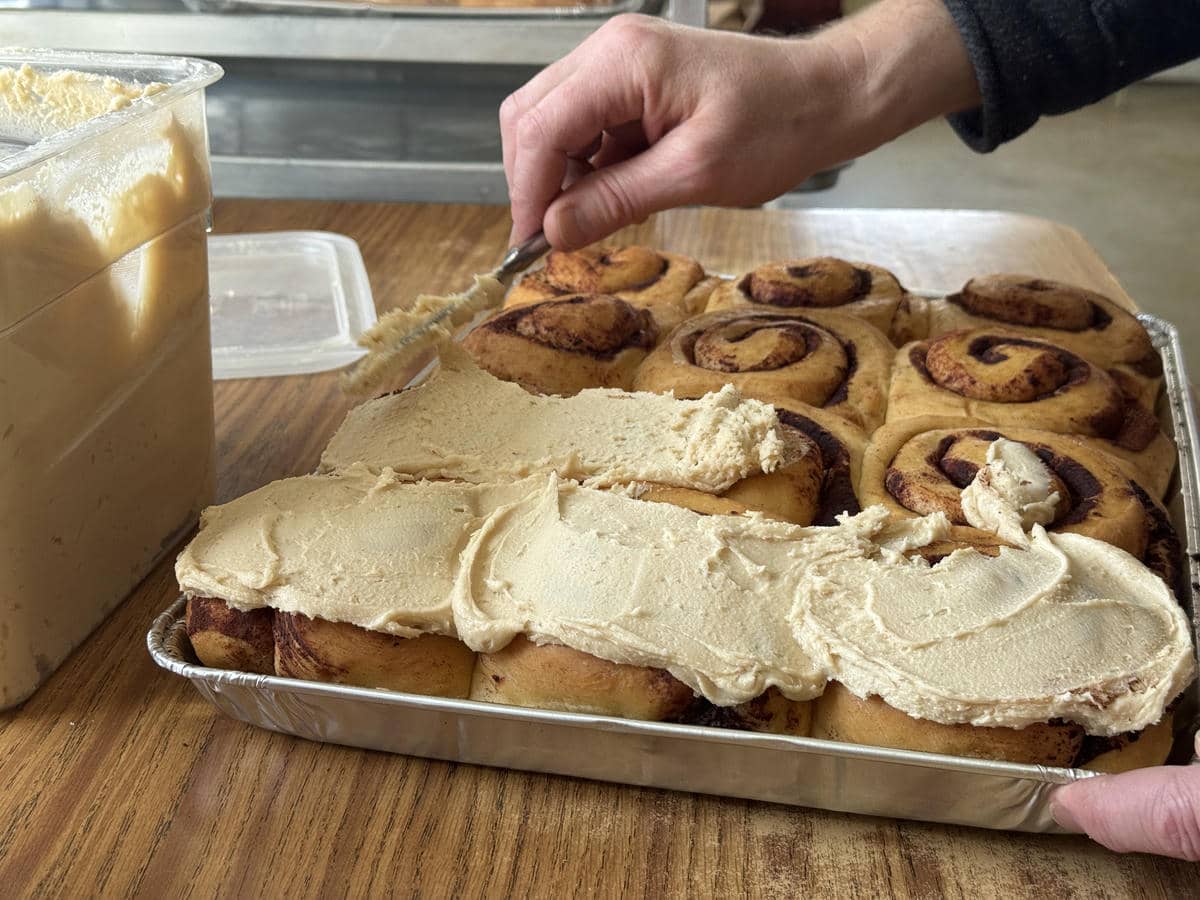
Country Lane Bakery still uses Ida’s recipe for cinnamon rolls, although Vernon and Joann added vanilla, caramel, and cream cheese frostings. In the summer, the bakery may produce as many as 250 dozen cinnamon rolls a week. Before Thanksgiving, they make nearly that many, besides many pies and other items, in just three days’ time.
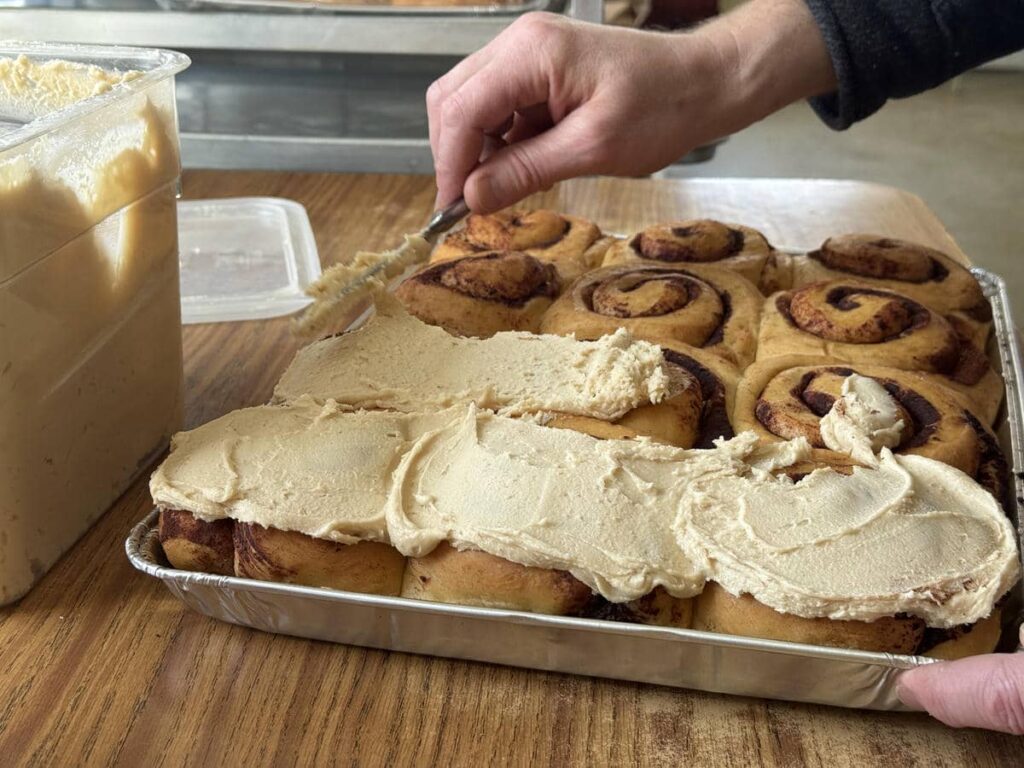
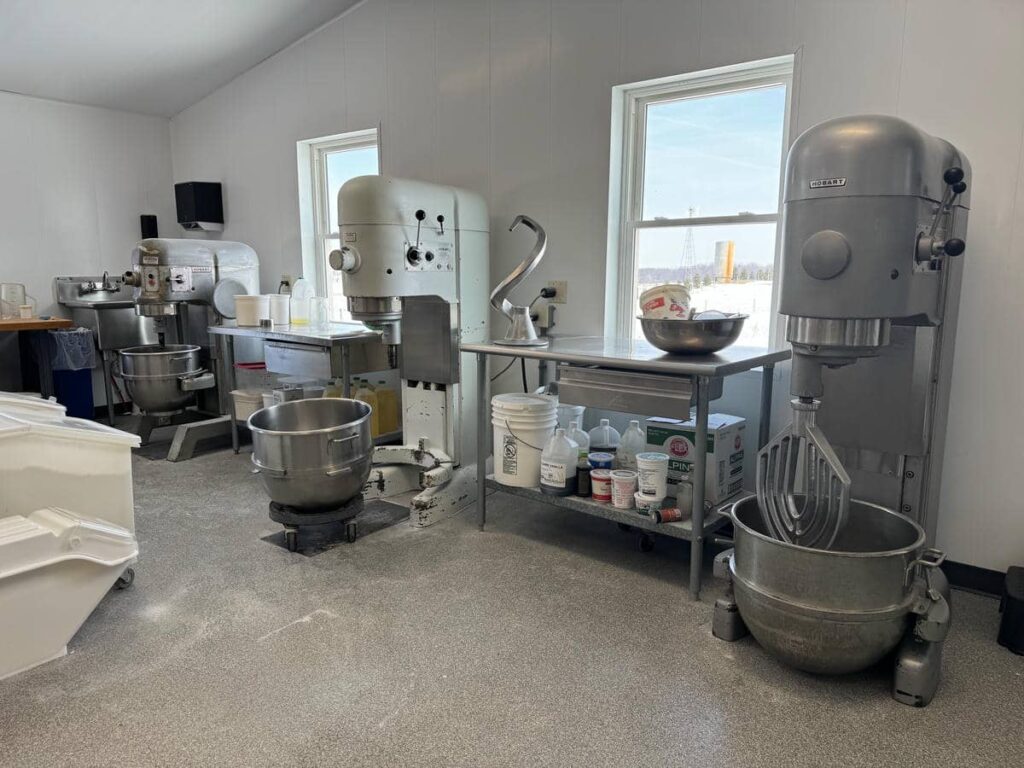
While not every item is made every day, the bakery’s brochure lists over a hundred items that can be ordered. Beyond cinnamon rolls, they are especially known for both honey oat bread, made sugar-free and sweetened only with honey, and sour cream cookies with butter icing. They pay attention to quality, setting aside products that look inferior. They also use no preservatives. Except for a few items like Bavarian and raspberry filling, they make everything from scratch.
Vernon’s dad still helps out at the bakery. Howard’s illness has not gone away, but it has not progressed quickly. Still, following several falls, he can no longer walk, yet he rides over to the bakery on his battery powered scooter and transfers to a rolling chair. He washes a lot of dishes, frosts rolls, and assembles boxes.
Howard and Ida didn’t just “make a go” of their country bakery. In the face of a crippling illness, Howard has lived to see his son take the business over and even start a second location—where his wife’s cinnamon rolls are still one of the hottest items for sale.
Country Lane Bakery is located at 59162 CR 43, Middlebury, IN 46540 and can be reached at 574.825.7918. Hours: Tuesday–Friday, 5:00 to 2:00; Saturday, 5:00 to 1:00.
Country Lane Bakery 2.0 (the café) is located at 120 Morton St., Shipshewana, IN 46565 and can be reached at 260.293.1255. Hours: Tuesday–Friday, 5:00 to 2:00; Saturday, 5:00 to 2:00.
Katrina is the author of eighteen books, most recently the Brady Street Boys adventure series. She lives with her husband Marnell and their daughter in Elkhart, Indiana.