
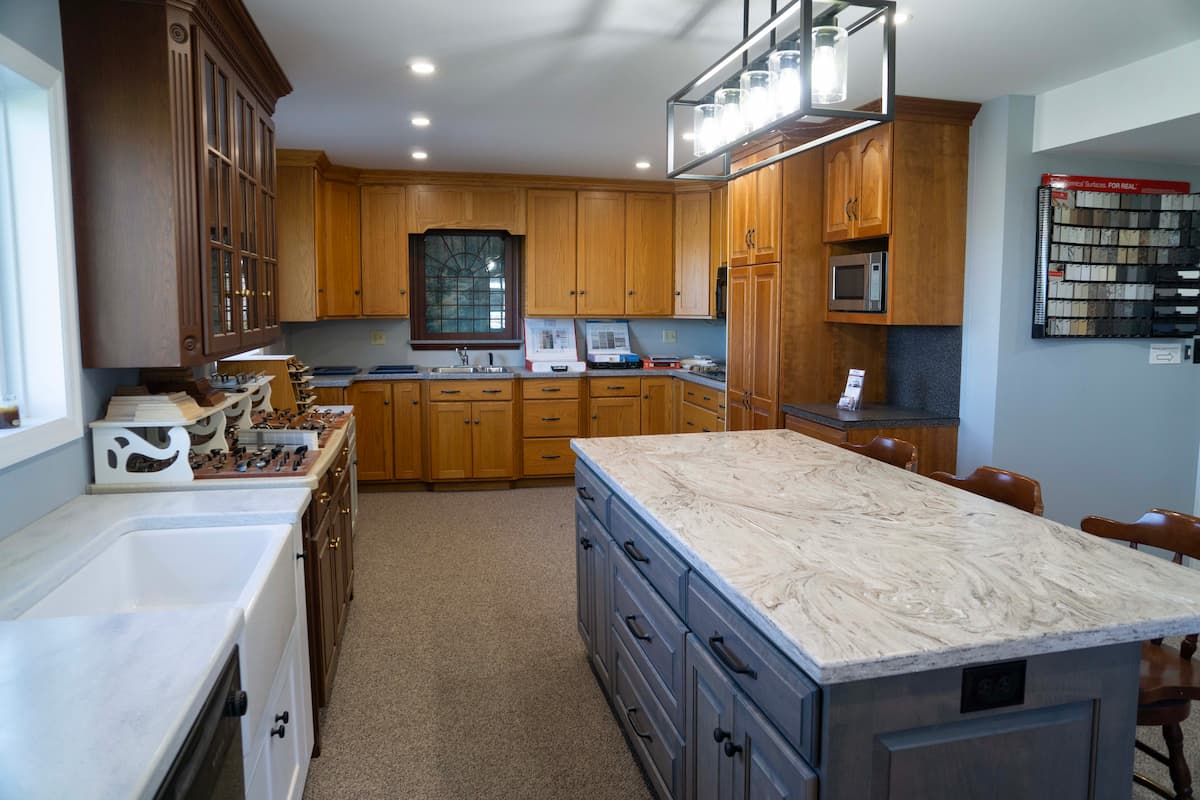
At Rissler Custom Kitchens, the Rissler family crafts custom cabinetry made to last for many years. The cabinet shop is surrounded by farmland on Brethren Church Road in Leola. Anyone is welcome to stop and view cabinet options in the showroom. Potential customers can make appointments for evenings and Saturdays since the Risslers live next door to the shop.
John F. Rissler, the current patriarch of the cabinet shop, started building cabinets about the age of fifteen. Now nearly five decades later, he still works daily in the shop. John and his wife Janet have nine grown children. All the children have worked in the shop, but at present only Randall, Kyler, and Kiera work full-time with their father.
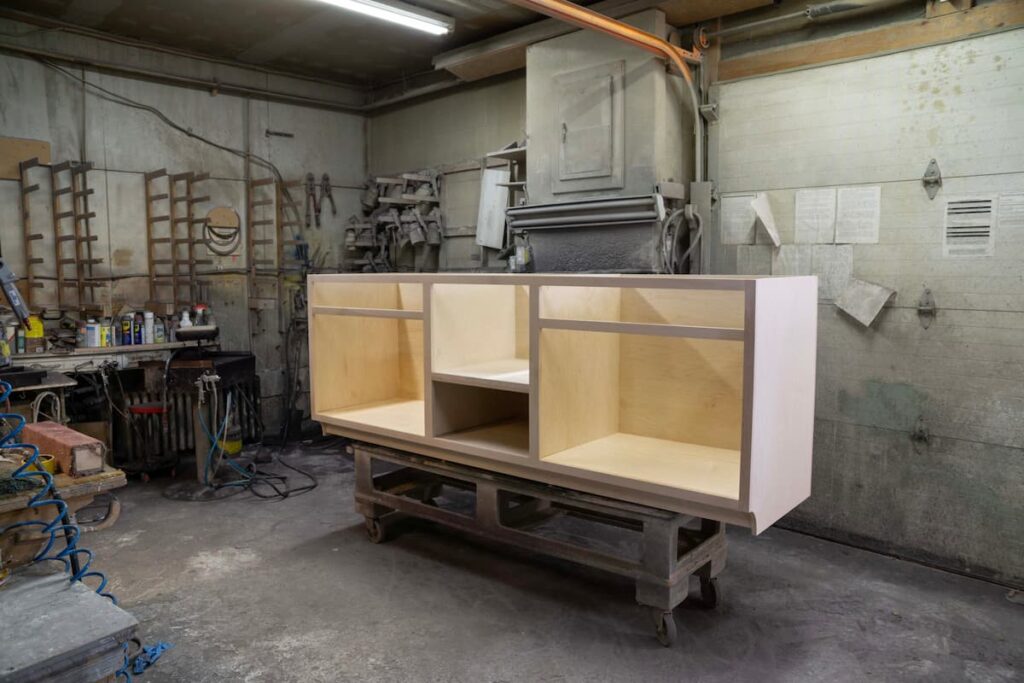
Although they have flexible roles, every family member focuses on certain tasks. John finishes cabinets and does office work. Kiera makes doors and frames. Randall assembles the cabinets and fixes any equipment that needs fixing. Kyler designs the kitchens and helps sand and paint the cabinets.
“We don’t use pre-set sizes,” Kyler says. They build every kitchen to fill the customer’s exact specifications, with no filler pieces or factory cabinets. The Risslers also build bathroom vanities and other built-in furniture pieces like bookcases, window seats, or desks, but no stand-alone furniture.
From start to finish, it takes the family an average of three weeks to finish a set of kitchen cabinets.
Usually, they work with a contractor who installs the cabinets in the homes, but if needed and the customers live within several hours’ drive, John or Randall deliver and install the cabinets themselves. As a family favor, they have delivered kitchens to relatives in Florida.
Nobody at Rissler Kitchens has formal education in carpentry or business. John remembers being asked as a young man, “Where did you go to school to learn woodworking?”
“And I said I didn’t go through any, and he was dumbfounded.” John values hands-on learning. “What college or school can be better than being in the actual wood shop?” His children have all learned the same way, a little bit here and there until they can handle almost any job in the shop.
Next to the parking lot of Rissler Kitchens, a lane leads back to a farm where the Rissler family once lived. While living on the farm in the 1950s, John’s late father, John M. Rissler, who always liked woodworking, built a cabinet for his wife, Alice. More cabinets for other relatives soon followed, including a complete kitchen for his brother- and sister-in-law. In 1960, John Sr. converted an old chicken house into a woodshop and cabinet showroom, and for the next ten years, he made kitchens and farmed.
In the late ‘60s, John Sr. and Alice decided the time had come to quit farming and focus on the cabinet business. They built a new house and a much larger shop on a portion of the farm next to the road. They moved their six children and the cabinet business to the new property. (Today, John Jr. and Janet live in this house.)
As his children grew up, John Sr. taught them woodworking. If he saw them stirring stain without holding the can or not holding a piece of wood steady while sanding or staining it, he would tell them, “Use both hands! That’s why God gave you two hands.”
John Sr. honed his cabinetry skills all his life. When Corian countertops were popular several decades ago, the manufacturer DuPont required all Corian installers to attend classes about their product. “My dad was 60 years old when he first went, and he met a young man there who wanted to know how old he is. When my dad told him, he said, ‘Oh, why would you even bother anymore?’ Well, my dad was making Corian tops for the next twenty-four years,” John Jr. remembers.
John Sr. remained a cabinet maker until his death in 2017. Even in his seventies, he would sometimes stay up all night finishing a kitchen job to meet a deadline.
Eighty percent of the cost of a new kitchen is labor. John Sr. charged by the foot, a swift way to calculate the price, but not always accurate. He focused on craftsmanship and wanted to be certain he didn’t shortchange customers.
After his passing, the family re-evaluated the pricing structure. “It sounds very capitalist of me, but you’re in business to make a profit. If you’re not making a profit, you’re making a loss,” Kyler says. “It’s hard to hit that sweet spot, knowing you’re not going to lose money on this job, and yet you’re not overcharging.”
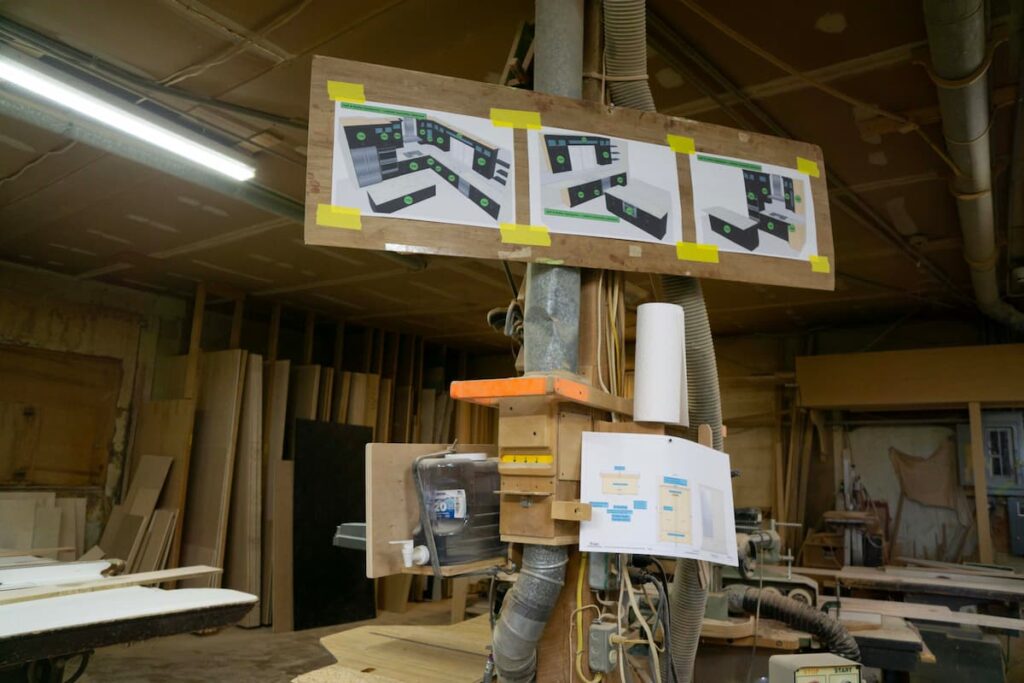
Kyler, now the business estimator, uses Mozaik software to help find a fair price. He uses the same software to help design kitchens, a task his grandfather once did with paper and pencil.
Although the basics of creating solid wooden cabinets haven’t changed much over the years—there are still the frames, doors, and drawers—styles have. The most obvious change has been the move from stained and varnished cabinets with visible wood grain to the now popular painted cabinets, usually in a shade of white. Privately, the Risslers shake their heads: to a cabinet maker, wood grain beats anything from a paint can.
“Painted Shaker style, that’s just what everybody wants. And I think it’s a shame because I think wood is beautiful,” Kyler says. He guesses about 90% of their customers want painted cabinets. “It’s a modernist look and easy to clean.”
Contrary to many people’s assumptions, painted cabinets cost more than wood-finished, because the wood must be flawlessly smooth, every nook and cranny filled in with putty before being painted. And while every cabinet leaving Rissler Kitchens is coated with professional-grade conversion varnish, which dries to a hard, shell-like finish, the inevitable nicks and scratches show up much quicker on painted surfaces than stained.
All painted cabinets are made from maple wood. Some customers choose to have one wood-finished cabinet as an accent piece, such as a kitchen island. Options for wood-finish cabinets include maple, oak, and cherry.
Cherry wood cabinets, while beautiful, present a problem when clear-finished: the depth of the color varies with how recently the wood has been machined. If Kiera or Randall cuts a door or a frame from a piece of cherry wood, the fresh surface will look pale in comparison to pieces that have been in storage and darkened with time. This can be a problem since the Risslers source two parts of a kitchen from other woodshops: the trim and the drawer boxes and store them until needed. “Over time, the wood will age to the same color, but the customers have a hard time believing you,” John says. He adds that once another local cabinet maker had an entire cherry kitchen rejected because a customer disliked the variations in color.
Other changes over the years include hardware, such as hidden European hinges, soft-closing drawer slides, and undermount drawer slides. Customers now like to add pullouts like spice racks, cutting boards, and inserts for better storage. Floating shelves, which are attached to the wall with concealed hardware, are common now.
Soffits, the panels that once filled the space between the top cabinets and the ceiling, are no longer desired. Soffits once hid pipes, ductwork or had sliding panels to tuck away seldom-used items behind. After the soffits’ popularity waned, customers wanted an open space between the cabinet and the ceiling, but that trend passed as well. Most modern kitchen cabinets now reach to the ceiling with only a molding at the top, even if that means getting a stepstool to reach the top shelf.
Other passé features include shelves on the side of the sink cabinets, colored plastic inserts in doors, and plate rails. However, glass doors with muntins to display dishes or tchotchkes remain popular.
Not everyone wants white cabinets. Presently the Risslers are working for a customer who selected a deep, dark purple for her kitchen cabinets and celestial blue for her laundry and walk-in pantry. “It wouldn’t be my first choice,” Kyler says. “But it’s not our place to judge customers for their choices.”
One of the customers that Kyler says he has learned the most from is a woman named “Tiffany.” When out of the blue Tiffany first contacted Rissler Kitchens, Kyler gave her a quote and but didn’t expect to hear from her again. Usually, the Risslers’ business comes from people who have a connection to an earlier customer.
To Kyler’s surprise, Tiffany accepted the price without questioning it, and she wound up hiring the Risslers to build cabinets for her kitchen, kitchenette, bathroom, and laundry room.
Tiffany, they learned, was the daughter of a home builder. She used Canva, an online platform, to organize her dreams of what she wanted in her new home. She had pages and pages of ideas for a kitchen. “She kept seeing things online. Then she came up with more new ideas, and she wanted to incorporate those. She was pleasant to work with, but she kept changing her design,” John says.
For example, to hide the washer and dryer in her laundry room, Tiffany wanted giant retractable doors with a decorative cutout in the door panel for ventilation so she could close the doors when the washer and dryer were in use.
“Some of her ideas weren’t exactly super practical, but I learned how to do things that we’ve never done before,” Kyler says.
Customer service remains a priority even with unpleasant customers. “We recently had a customer that rejected the refrigerator cabinet because I missed that his refrigerator required a deeper cabinet. He made us change it and the pantry unit beside it to a 32” deep cabinet. The pantry could have been lifted out from the wall. But no, he said he wanted to change both cabinets,” John says. The pantry wouldn’t have had to be replaced and only the customer would have known there was an empty space in the back, but the Risslers built another cabinet free of charge.
“It was technically our mistake, so we ate the cost,” Kyler adds. Integrity sometimes comes at the cost of profit.
Scheduling can also be tricky if multiple customers want their cabinets at the same time, since the woodshop has only enough room to work on one kitchen at a time.
John doesn’t pull all-nighters like his father once did, although he does work well over forty hours a week. “The saying is you have your own business; you can make your own hours. You can start any time before 7 and quit any time after 11 at night,” John jokes.
After a long day of painting or delivering a kitchen, John can walk across the lawn to get home. Inside the kitchen are oak cabinets, designed and built by his father and mother, now both gone. Janet loves her kitchen where her nine children can come for a meal and she has no desire to upgrade to a white painted kitchen.
Every day in their home, the Risslers use cabinets made at Rissler Custom Kitchens decades ago, reminding them that hard work and craftmanship can serve a family for generations.

Rissler Custom Kitchens is located at 90 Brethren Church Rd; Leola, PA 17540. Hours are Monday–Friday 8:00 to 5:00, evenings and Saturdays by appointment. To reach the Risslers call 717.656.6101 or visit their website at risslercustomkitchens.com
Susan Burkholder, a corporate buyer and freelance writer, lives in Leola, Pennsylvania, and has written for PCBE since 2023. A Lancaster County native, she did long-term volunteer work in Virginia and Ireland. Her favorite places include parks, libraries, and old houses. You can read more of her writing at pennyletters.com. Susan Burkholder is the granddaughter of the founder of Rissler Custom Kitchens and the niece of John and Janet Rissler.