
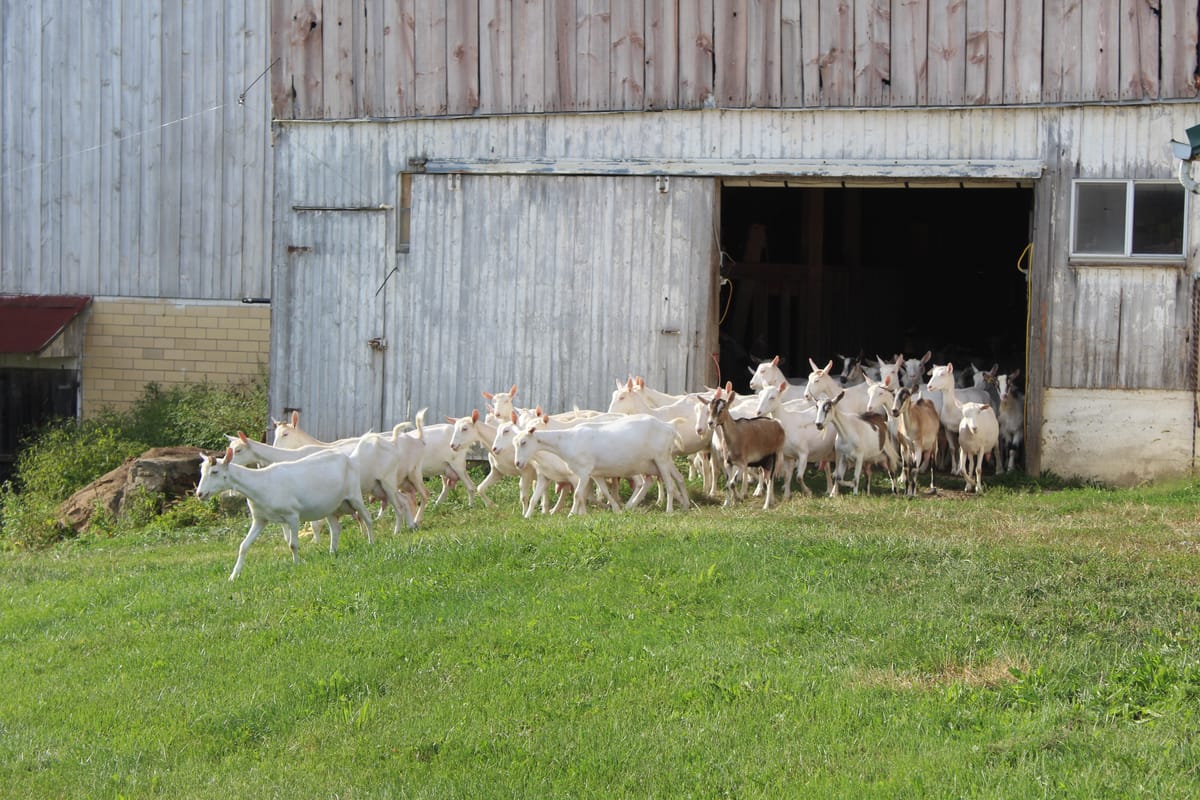
Joe Miller shook his head in disgust. Several of his workers kept spooking at loud noises or running away when bystanders watched. Many employers would have called a meeting, reviewed company policies, and asked them to wear hearing protection. Instead, Joe grabbed a stick, circled around them, and urged them to come back into their stanchions. That’s how you do it when you’re working with goats—and Joe works with more than a hundred of them.
Like many other young entrepreneurs, Joe had often dreamed of doing something on his own at home. The dream came close to reality when he went to the open house of a farm that was for sale. His heart skipped several beats as he walked over the property. The farmer in him came alive.
After buying the homestead and the five acres that came with it, Joe married Lori in 2022. Due to having only a few acres to accompany the large barn, Joe knew that dairy cows were not an option. He thought back to his youth when he dreamed of owning beef cows, but a better fit was his dream of dairy goats.
With visions of goat milk, Joe called Paint Valley Farms, a local creamery. They listened to his offer to milk goats, but they were hesitant to commit because of several factors. They encouraged Joe to hold off for now and speak with other goat farmers in case an opening ever came.
Joe picked up the phone and started asking for advice. Some goat farmers encouraged him, but others feared he would struggle to survive on only five acres since he would have to buy all his feed. In the meantime, another opportunity came along: a startup business was looking for a manager. Joe jumped for the opportunity at the new hardwood flooring company. But just a year later, Paint Valley called with interest in adding milk from another goat farmer.
Joe waffled, seriously considering it at first, but ultimately declined. He felt obligated to continue working for the flooring business. Still, he didn’t throw away the idea of doing something on the side and bought a used sawmill from Bright Star Auctions.
In the evening and on weekends, Joe began setting up the one-man sawmilling equipment. Additional secondhand pieces were bought as funds became available. At the same time, he and his brother David built a small cabin/mini house on his property that they envisioned could someday be used as an Airbnb.
Sawing Logs or Milking Goats?
Although a sawmill was not farm related, Joe was excited when he cut his first log in the spring of 2024. The first logs were for a church brother redoing his barn floor. The three boom-truck loads were soon cut into 6/4 planks, despite some bugs that had to be worked out along the way. The venture proved to be a financial success after the initial challenges were overcome, but not so much a marital masterpiece.
Joe and Lori were blessed with a son, and then another one soon after. The long hours Joe spent working took a toll on his family. Too often, he worked nine hours at the flooring company and then spent long hours into the evening, either cutting logs or fine-tuning his setup. It didn’t take long before their marriage felt the effects.
Joe wondered if the sawmill venture was a mistake. He called Bright Star about the possibility of selling the equipment. However, they advised him not to since the market was soft. Joe and Lori revisited the notion of milking goats with the idea of quitting his job at the flooring company. They gave Paint Valley another call.
However, Paint Valley’s need for goat milk was gone again. They had picked up a few other contracts in the meantime. But they finally called with good news a few months later, saying they might accept his offer to milk goats after all. By now, Joe was eager for a change. He enjoyed the connections he had through the flooring company, but his position brought lots of stress, and something had to give.
After receiving the green light from Paint Valley in November 2025, Joe wasted no time moving ahead. Joe spoke with Amish goat farmers from Kalona, Iowa, and soon decided their goats had the genetics he would pursue. The Iowa goats averaged around fourteen pounds of milk per day, with some producing up to 24 pounds a day, near the same amount as some small cows. It seemed to Joe that Kalona was the goat-farming capital of the Plain communities.
He traveled to Kalona later in the month with a rented livestock trailer, a pen, and a checkbook. He returned home with a truckload of 68 young, bred Saanen nanny goats, one billy, and a bellyload of butterflies. Would it work to be a goat farmer?
Birthing Goats When It’s Twenty Below
Joe quit his job at the flooring company in January 2026. The first few weeks weren’t what he dreamed of when he had thought of working at home. Near record-low temperatures blanketed Holmes County, with the lows hovering around twenty below zero the first week. Additionally, all the equipment in their facility had to receive a grade A inspection so he could legally sell goat milk, and the water inspection failed the first few times.
In the meantime, Joe bought an additional 25 goats from a Missouri farmer who had goats with the Kalona genetics. The nanny goats began birthing in February. Joe checked them every night since temperatures were still brutally cold. He milked the first few nannies by hand, until there were enough to make it worth using the parlor.
Immediately after birth, the little kids were taken away from their mom and bottle fed. Joe and Lori enjoyed this… for about a week. But after 80-plus goats gave birth to almost 120 kids, the initial hype was soon replaced with tiresome responsibility. “We had to remind each other that this too shall pass,” Joe said. Soon after the little ones learned to drink from a bottle, they began drinking on their own from a bucket with several nipples attached.
Meanwhile, Joe worked on finishing the stanchions and milking parlor set up. Instead of using bucket milkers, he hooked the milkers to a pipe that would directly transfer the milk to the tank. This proved crucial in saving him steps and time since he was a one-man show while his wife took care of the children. Joe eventually quit second-guessing his venture when warmer temperatures arrived and he and his “workers” got acquainted.
Performing in the Parlor
On most days, the barn lights flick on at 4:30 A.M. Joe starts by dumping buckets of grain along the stanchions in the parlor, which accommodates 24 goats at a time. After cleaning the goats’ udders with a wipe, Joe attaches the 12 vacuum milkers to the 12 goats on one side. While they enjoy breakfast and donate their portions to the tank, Joe is busy bringing in 12 more goats on the opposite side by simply pushing open a sliding door.
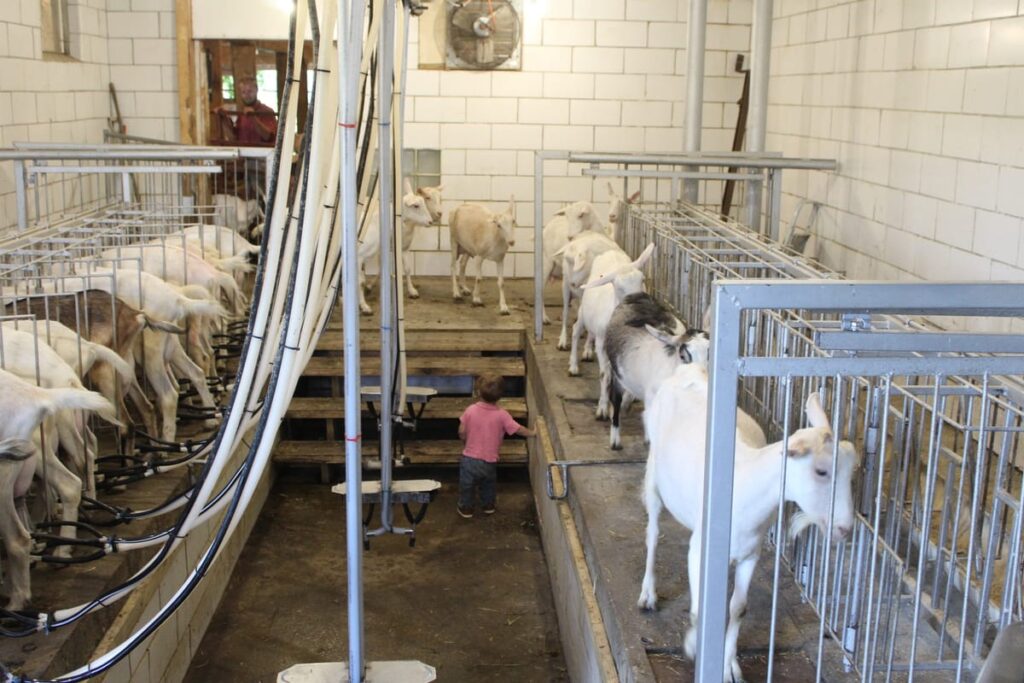
As soon as the first batch of goats is done milking, Joe swaps the milkers to the goats on the other side and repeats the process. A new group of 12 goats is brought in every 8 to 9 minutes. The stanchions are made so that as one goat steps into the first slot, the next slot opens. The goats walk in single file and the stanchions clang shut like a row of metal dominoes.
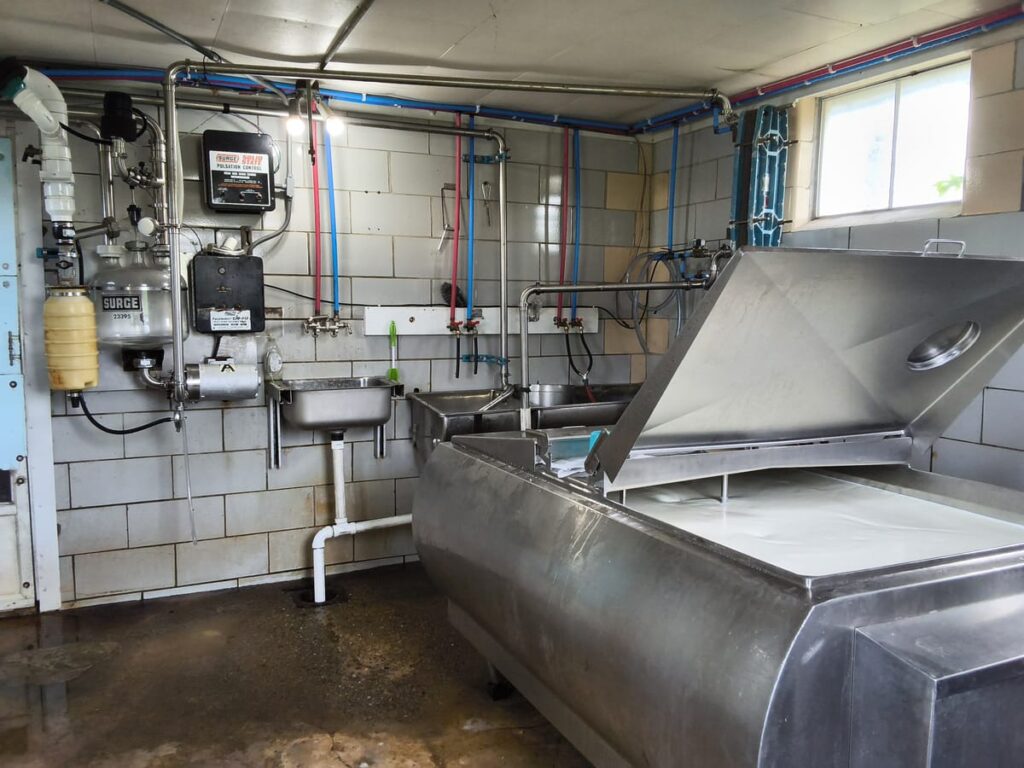
An essential part of retaining the rich flavorful texture in goat milk is to cool it quickly. That’s why Joe installed an advance-cooling pipe system that cools the milk before it even reaches the main cooling tank, where it cools to 40 degrees.
Goat Maintenance
The biggest challenge has been feeding the goats since they can be picky eaters. For instance, they rejected a semi-load of western alfalfa hay because it wasn’t the right texture. Joe ended up using half of it as bedding. However, he knew that paying $400 a ton for hay and basically throwing half of it away would not be sustainable long-term.
Currently, the yearling goats are producing around eight pounds of milk per day. Joe knows that in order to increase that number to up to the “Kalona range,” he must feed them something that they stuff themselves with.
Twice every year, adult goats’ hooves need to be trimmed. This consumes most of a day. To illustrate why, consider: 150 goats with 4 legs that all have 2 hooves makes 1,200 hooves to trim. And that number is going to increase as Joe plans to enlarge his herd by adding the baby nannies to his milking herd, while sending most of the billies through Mt. Hope Auction, where they are purchased for meat.
Bedding gets cleaned out twice per year and is composted. The combined goat droppings, hay, straw, and sawdust make the compost well balanced, creating a nutrient-dense organic fertilizer that supports healthy plant growth. The compost is for sale to anyone interested in adding it to a garden or raised bed. The bedding is sold by the skid loader bucket.
A concern the young family had was who would milk the goats for them if something unexpected came up. A solution was found in a growing neighboring family. This family now milks the goats both morning and evening every Tuesday. This keeps them up to speed with the duties of the farm and gives Joe and Lori a break from the responsibilities.
The Supporting Cast
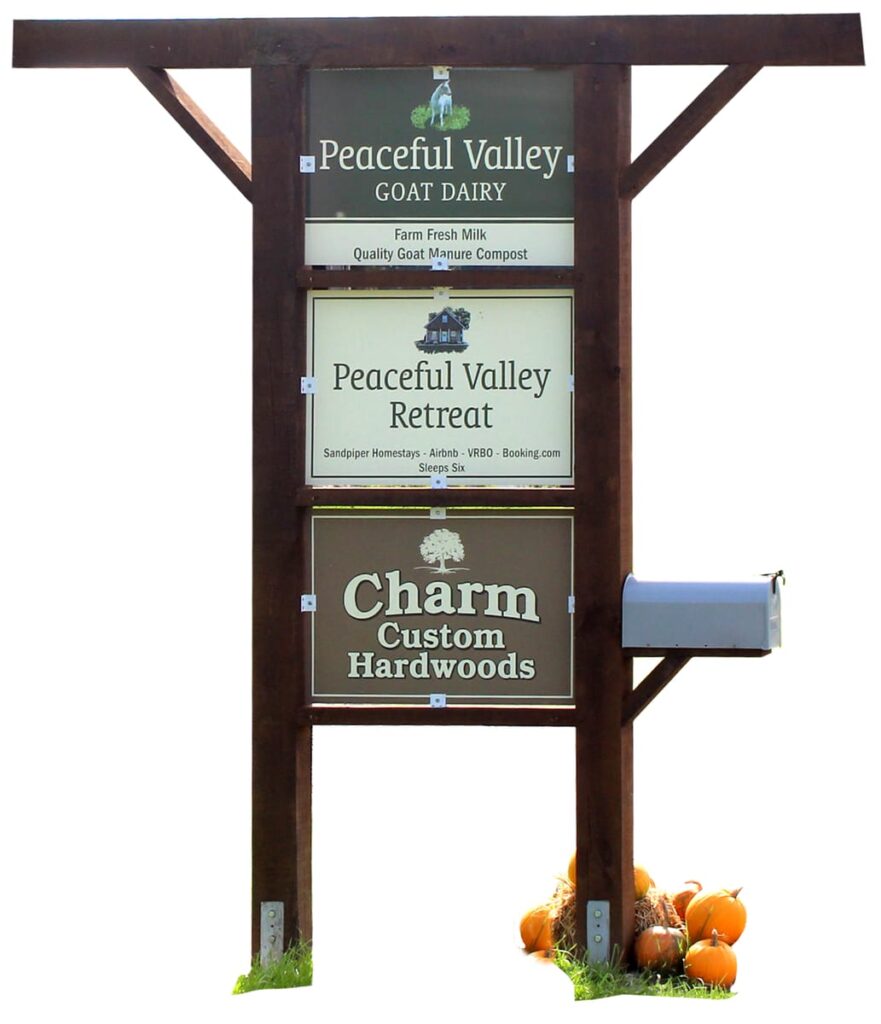
Joe and Lori still have the cabin Joe built with his brother, David. They partnered with an Airbnb firm and started renting it out after his brother moved out of it. Called Peaceful Valley Retreat, the cozy little getaway has a hot tub, a loft, and sleeping arrangements for six people.
The experience has been encouraging so far. On numerous occasions, customers at the Airbnb have visited the dairy barn to watch the goat milking show. The side income has been a big blessing. Since Joe and David finished the interior of the cabin themselves, they did not accumulate much debt on the project. In the future, Joe hopes to have brochures available at the Airbnb that formally invite guests to visit the performance in the parlor.
The sawmill has also played a vital role in the goat business. Not only has it paid for itself and generated a vital side income, but the sawdust it produces is also valuable bedding for the farm. Joe hardly ever has to buy additional sawdust.
Most weeks, Joe cuts logs three days in the forenoon from 7:00 to noon. A young lad from church usually stacks the lumber. Joe’s biggest jobs have been for his father-in-law, who is a part owner of a local chair and furniture manufacturer.
On a side note: Joe would encourage anyone looking for a small sawmill to buy a secondhand mill and refurbish it instead of spending big dollars on a new one. By fixing it up, he understood better how everything worked and often knew how to fix things when something malfunctioned.
Converting the Neighborhood
Joe’s neighbors were hesitant at first to try goat milk. Some have since repented, while others have yet to try the nutrient-rich milk considered a versatile dairy alternative. Goat milk provides a variety of essential vitamins and minerals considered vital to our overall health and well-being.
Joe is grateful, though, to all the neighbors who have welcomed and assisted them in some way, even if they haven’t tried his favorite milk. Because he grew up in Indiana and moved to his Ohio home only a few years ago, there weren’t many familiar faces.
Beyond the challenges and the unrepentant cow-milk-drinking neighbors (such as this writer), the highlight for Joe has been working at home and doing what the farmer boy in him wanted to do all along. On most days, he spends a total of three hours milking the goats. For him, waking in the morning to 150 hungry goats appeals more than jumping into a van and going to work.
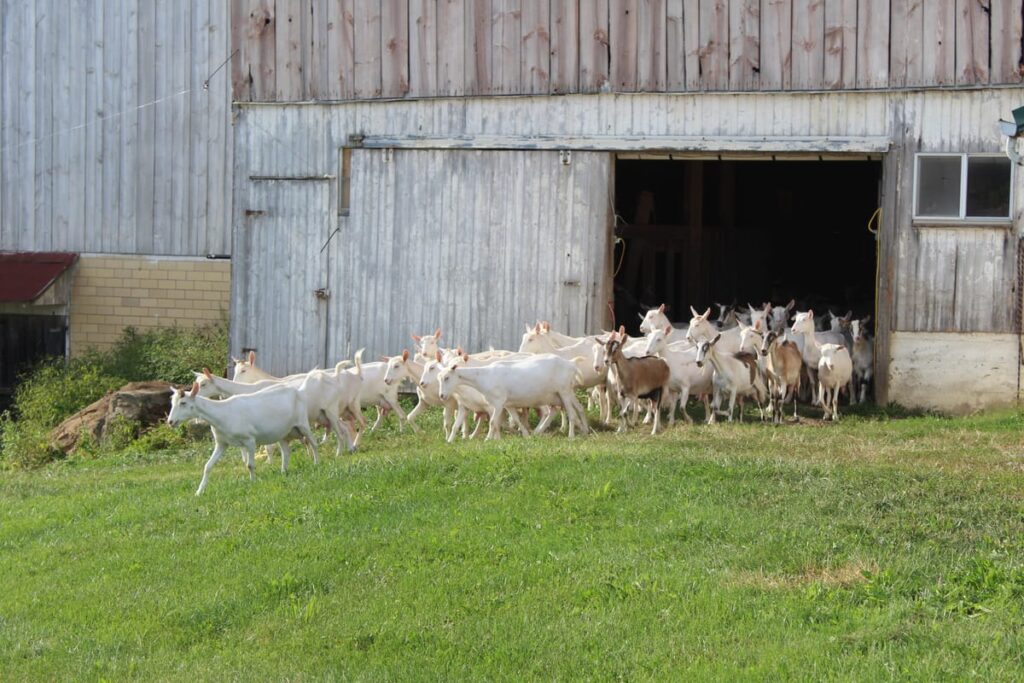
As the first year concludes, Joe and Lori think it is a success. Not everything was perfect, but neither did they expect it to be. They have proven that dreams can become a reality if you roll up your sleeves and allow others to speak into your life—even with only a few acres. Sometimes all it takes is to think a little bit outside the box.
About the Business
Peaceful Valley Goat Dairy is in Holmes County, Ohio, at 3538 Township Rd 157, Sugarcreek, OH 44681. They can be reached by phone at 330.600.8772, or by email at joewithpeacefulvalley@gmail.com.
About the Author
Marion Kuhns lives in Holmes County, Ohio, with his wife and children, dividing his time among work, freelance writing, and the occasional game of Candy Land. Local businesses in the greater Holmes County area interested in being featured in PCBE may contact Marion directly at 234.799.0008.